

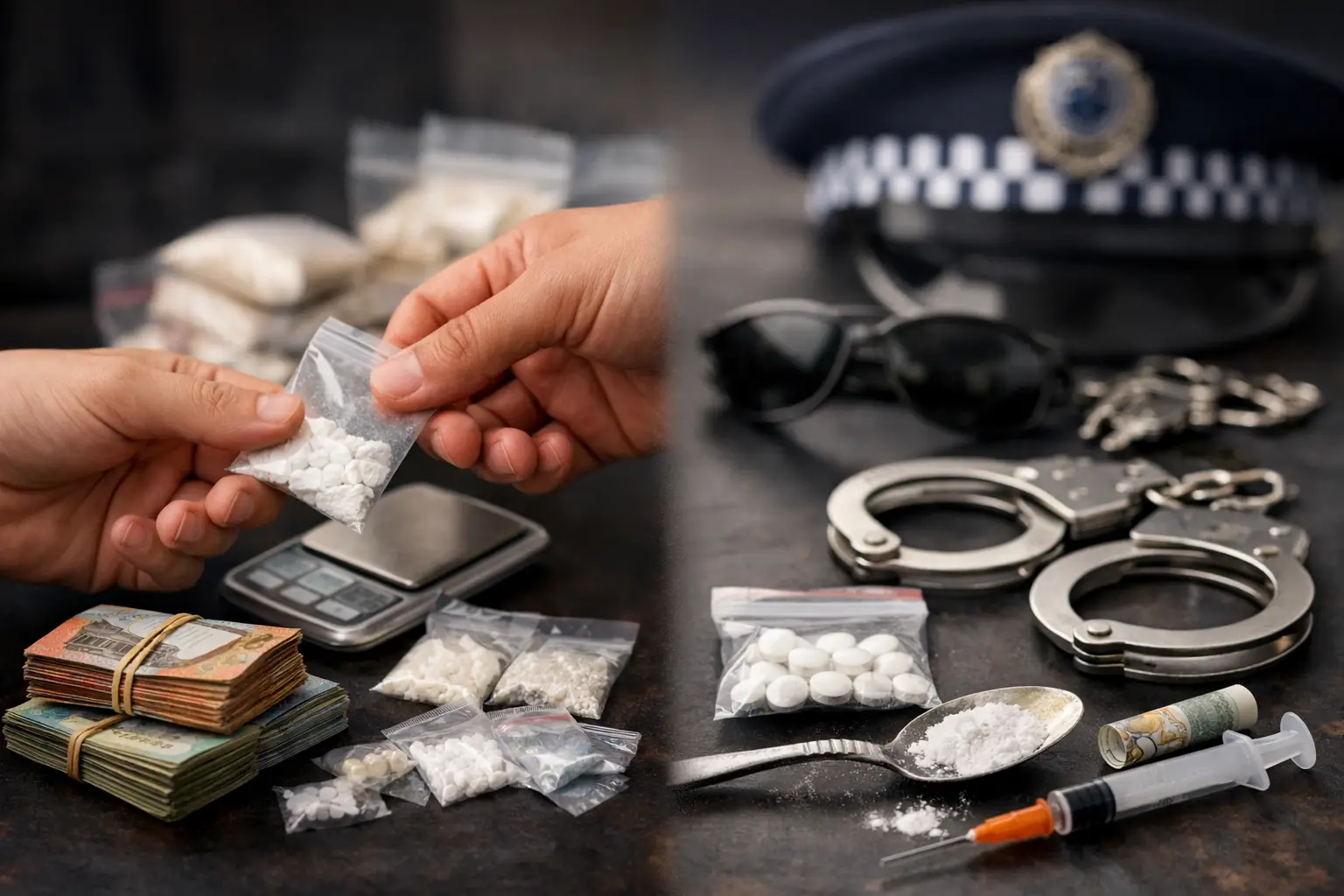
Police may find drugs during a vehicle stop, a search at a music festival, or after executing a warrant at a home. What happens next can turn on a crucial distinction: drug supply versus possession. The substance itself may be the same, but an allegation of supply carries a very different level of risk for your freedom, career and future.
In NSW, police do not need to catch someone handing drugs to another person to lay a supply charge. The quantity of the drug, messages on a mobile, cash, packaging and other surrounding circumstances can all be used to allege an intention to supply. If you have been charged, early legal advice matters. What you say, what police seize, and how the case is approached from the outset can shape the outcome.
What is drug possession in NSW?
Under the Drug Misuse and Trafficking Act 1985 (NSW), possession generally means having custody or control of a prohibited drug. It does not have to be in your hand or pocket. Drugs found in a backpack, glove box, bedroom, wallet or other place you control may lead police to allege possession.
The prosecution must still prove beyond reasonable doubt that you knew the substance was there and that you had control over it. That is not always straightforward. A shared car, shared home or borrowed bag can create real issues about who the drugs belonged to and who knew about them.
Possession is commonly dealt with in the Local Court and carries a maximum penalty of two years imprisonment and/or a fine. That maximum does not mean every case results in jail. The outcome depends on the drug, quantity, your history, the circumstances of the offence and the quality of the material placed before the court.
For a first offence involving a small quantity and strong subjective material, alternatives to conviction may be available in some cases. But possession should never be treated as a minor inconvenience. A conviction can affect employment, travel, professional licences, family matters and your reputation.
Drug supply versus possession: the legal dividing line
A supply charge alleges more than personal use. Supply can include selling, distributing, agreeing to supply, offering to supply, administering a drug, or possessing it for the purpose of supply. Money changing hands is not essential.
For example, giving a pill to a friend, arranging a sale through messages, or holding drugs for another person may be alleged to be supply. The prosecution will assess the full picture rather than one fact in isolation.
A supply allegation can be based on evidence such as:
- the amount and type of drug seized;
- separate bags, wraps, scales or other alleged dealing equipment;
- cash and financial records;
- text messages, social media messages or call records; and
- admissions made during a police interview or in conversation with others.
None of these matters automatically proves supply. There may be innocent or alternative explanations, and the evidence must be tested carefully. A quantity of drugs may be consistent with personal use. Cash may have a lawful source. Messages can be incomplete, taken out of context, or linked to somebody else using the device.
The difference is significant because supply is treated far more seriously than simple possession. Depending on the amount of the drug and the circumstances alleged, supply matters may proceed beyond the Local Court and expose a person to lengthy terms of imprisonment.
Deemed supply: when quantity changes the case
One of the most important concepts in NSW drug law is deemed supply. If police allege you possessed at least a traffickable quantity of a prohibited drug, the law can presume that you had it for the purpose of supply.
This means the case may begin as a supply allegation even where police have no evidence of an actual sale. The relevant quantities differ between drugs and are set out in legislation. They can be surprisingly low for certain substances.
In a deemed supply case, the central issue is often whether the presumption can be displaced. The defence may need to show, on the balance of probabilities, that the drugs were not held for supply. That can require a strategic and carefully prepared response. Simply telling the court the drugs were for personal use may not be enough without credible evidence and a coherent explanation.
This is where getting advice before entering a plea is critical. A guilty plea to supply can have consequences well beyond the immediate sentence. Equally, pursuing a defended hearing without a clear legal basis can increase pressure, cost and risk. The right path depends on the evidence, the quantity, your instructions and the available defence.
How police try to prove a supply charge
Police investigations often extend well beyond the drugs seized. They may seek access to your mobile, analyse messages, obtain financial material, rely on surveillance, or interview other people connected to the allegation.
A mobile can become a major part of a supply case. But it is not automatically decisive. Police must establish what particular messages mean, who sent them, who used the device and whether the alleged conversations actually relate to drugs. Context matters. So does the legality of the search and the way the evidence was obtained.
Police may ask you to participate in an interview after arrest. You have the right to obtain legal advice before answering questions. An interview can be used to clarify an innocent explanation, but it can also create damaging admissions or apparent inconsistencies. Do not guess, fill silence with explanations, or assume you can talk your way out of a serious allegation without advice.
Penalties and sentencing for supply offences
The maximum penalty for drug supply in NSW is substantially higher than for possession. The precise maximum and likely court pathway depend on the quantity category, the drug involved and the charge laid. Commercial quantity and large commercial quantity allegations are among the most serious drug matters and can be prosecuted in higher courts.
Sentencing is not determined by quantity alone. A court may consider whether there was financial gain, the level of planning, the duration of alleged activity, whether other people were involved, prior convictions, rehabilitation, prospects of reoffending and personal circumstances.
A person with a limited role in a wider operation should not necessarily be sentenced as though they organised it. Conversely, evidence of repeated sales, significant profit or a sophisticated operation can aggravate the case. This is why a supply charge needs an individual defence strategy rather than a one-size-fits-all response.
Where a guilty plea is appropriate, preparation can make a material difference. The court needs reliable evidence of your background, employment, caring responsibilities, treatment, rehabilitation and genuine insight. References, medical reports, counselling records and a carefully considered letter of apology may all assist, but only where they are authentic and relevant to the case.
Defence issues that can change the outcome
Every drug matter turns on its own evidence. In supply and possession cases, common issues can include whether the search was lawful, whether police can prove the substance was a prohibited drug, and whether you knew it was present.
Constructive possession is frequently disputed. If drugs were found in a house with multiple occupants, a vehicle used by several people or a bag that was not exclusively yours, the prosecution must still prove control and knowledge. Suspicion is not proof.
There may also be disputes about the weight of the drug, continuity of exhibits, the interpretation of communications, or whether an alleged admission was voluntary and reliable. In deemed supply cases, the focus may be on evidence showing personal use rather than intended distribution.
A lawyer should assess the brief before final decisions are made. That includes the police facts, certificates of analysis, body-worn video, search documents, records of interview and digital evidence. The prosecution bears the burden of proof in a defended case, and weak assumptions should be challenged.
What to do after being charged
If police charge you with possession or supply, keep your paperwork, comply with bail, and write down your recollection of events while it is fresh. Do not contact witnesses to discuss their evidence, delete messages, dispose of devices or attempt to coordinate accounts. Those actions can create further legal problems.
Get urgent advice about your court date, bail conditions and the evidence police say they have. If you have a drug dependency, mental health condition or other issue affecting the allegation, seek appropriate treatment early and retain records. Taking practical steps is not an admission of guilt. It can protect your health and may become important if sentencing is later required.
A charge is not a conviction, and a police allegation is not the final word. Whether the issue is drug supply versus possession, a deemed supply allegation, or a disputed search, the strongest response begins with clear advice and a defence built around the actual evidence. KRAYEM & CO Lawyers can assess the position quickly and fight for the best available outcome from the first court date onward.